


South Sea Bubble 1720 How FOMO Ruined Sir Isaac Newton and British High Society
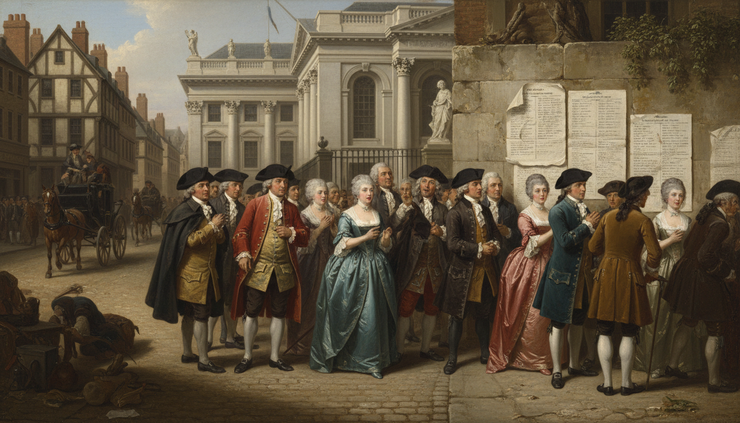
In the summer of 1720, London developed a fever. One could feel it in coffee houses, clubs, drawing rooms, and the corridors of Parliament. Fortunes seemed to rise by the hour. Servants whispered about shares. Dukes compared subscription prices. Members of Parliament, bishops, poets, merchants, and courtiers all watched one company as if it had discovered a new law of nature.
The company was the South Sea Company. Its promise was dazzling: access to trade with Spanish America, government backing, rich dividends, and a chance to turn paper into wealth almost overnight.
The promise was also largely fantasy.
At the centre of this scene stood Sir Isaac Newton, the most celebrated mind in Britain. He had explained gravity. He had mapped the motions of planets. He had served as Master of the Mint and understood money better than most people alive.
Yet even Newton was pulled back into the crowd at the worst possible moment.
The story of the South Sea Bubble is more than an episode in financial history. It is one of the great stock market mania stories because it shows how fear of missing out can overpower caution, status, memory, and even genius.

The South Sea Company sold a dream bigger than its ships
The South Sea Company began in 1711, not as a reckless gambling den, but as a clever piece of public finance. Britain had heavy debts after years of war. The government wanted a way to manage them. Investors wanted safe income and a share in imperial opportunity.
The company’s name carried enormous force. The “South Seas” meant the Spanish Empire’s territories in South America. To ordinary investors in London, that sounded like silver, sugar, wealth, ships, and endless markets waiting to be opened.
Reality was duller. Spain tightly controlled trade with its colonies. Britain’s actual right to trade in the region was limited. The company’s commercial prospects did not match the dreams being sold in pamphlets and conversations.
But in a speculative mania, details become irritating. People do not buy the present. They buy the story.
The South Sea Company offered a seductive one. It proposed to take on large parts of the national debt. In exchange, debt holders could swap government obligations for company shares. The scheme tied the company to the state, which gave it an aura of safety. If Parliament approved it, if ministers supported it, if great names joined it, surely it could not fail.
That confidence became the fuel.
Shares rose. Then they rose faster. Early buyers made money, at least on paper. Their gains became advertisements. A neighbour who had doubled a stake did more to persuade people than any official prospectus could.
London watched wealth appear from nowhere. The lesson travelled quickly through society: those with courage would be rewarded, while the cautious would be left behind.
That is the emotional core of every bubble. Price becomes proof. Rising numbers begin to replace judgement.
British high society turned speculation into a social ritual
By 1720, speculation had become fashionable. To be near the action was to be modern, informed, and connected. The mania swept through British high society because it was not just about money. It was about rank, access, and fear of social humiliation.
The wealthy gathered information in the places where influence lived:
Coffee houses where rumours moved faster than carriages
Drawing rooms where aristocrats compared allocations
The Royal Exchange where crowds watched prices
Westminster, where politics and profit mixed freely
Private clubs where names mattered as much as numbers
The South Sea scheme did not reach high society from below. It entered through the front door. Court figures, politicians, and financiers gave the project glamour. The company’s directors cultivated influence. Parliament itself became part of the theatre.
When powerful people appear to be making easy money, caution starts to look foolish. Nobody wants to be the person at dinner who missed the obvious opportunity. Nobody wants to admit that they do not understand the scheme. Nobody wants to stand outside while everyone else steps into the golden room.
This is where FOMO becomes social pressure. It is not only the fear of losing money. It is the fear of losing status, belonging, and the right to say, “I was there.”
The Bubble also inspired copycat schemes. London filled with new ventures, some plausible, others absurd. Projectors advertised companies for mining, insurance, manufacturing, trade, and strange inventions. Some proposals were little more than a title and a promise.
One notorious example, often retold as a symbol of the age, described a venture “for carrying on an undertaking of great advantage, but nobody to know what it is.” Whether every detail of that tale survived accurately or not, it captured the mood perfectly. Investors were ready to fund mystery itself.
The crowd did not feel irrational from the inside. It felt early. It felt brave. It felt like the future had arrived and only timid people still asked questions.
Sir Isaac Newton knew when to sell, then FOMO pulled him back
Newton’s role in the South Sea Bubble is what makes the story so haunting.
He was not a naïve gambler. By 1720, he was elderly, respected, and rich by the standards of the day. He had served as Master of the Mint since the late seventeenth century and had spent years dealing with coinage, forgery, and the practical machinery of money. He understood fraud. He understood measurement. He understood risk better than most of his peers.
At first, Newton appears to have acted wisely. He bought South Sea shares and sold early, taking a profit. That should have been the end of his story.
But then prices kept rising.
Other people continued to boast of gains. The company became the conversation of London. A decision that had once seemed prudent began to feel like a mistake. Selling early can feel worse than losing, because every new rise looks like a rebuke.
Newton watched the crowd grow richer without him.
So he bought again.
This second entry was disastrous. He returned near the height of the mania, when optimism had already outrun sense. When the share price collapsed, Newton was trapped with everyone else. His losses are commonly reported at around £20,000, an immense sum at the time. The exact comparison to modern wealth is difficult, but it was enough to make the fall legendary.
The line most often attached to his ruin is unforgettable:
“I can calculate the movement of stars, but not the madness of men.”
The quote is widely attributed to Newton, though like many famous historical sayings, its exact wording and source are debated. Its power survives because it expresses a truth that no balance sheet can capture. Human behaviour does not move like a planet. Crowds do not follow neat laws. Desire bends judgement.
The Isaac Newton financial loss sits among the most memorable stock market mania stories in the long record of historical market crashes because it destroys a comforting myth. Intelligence alone does not protect people from bubbles.
Newton had the brain to understand the mathematics of motion. But the South Sea Bubble did not mainly attack the intellect. It attacked the emotions.
It used regret. It used envy. It used reputation. It used the need to belong.
And those forces can reach anyone.
The crash exposed how thin the dream had always been
By late summer 1720, confidence began to crack. Shares that had risen with astonishing speed began to fall. The same crowd that had fed the boom now fed the panic.
A bubble turns because people start asking a question they should have asked earlier: who will buy from me at a higher price?
Once that question spreads, the story changes. Buyers vanish. Sellers crowd the exits. Prices that seemed solid become air.
The South Sea Company’s share price plunged. Paper fortunes disappeared. Families who had felt rich in June felt ruined by autumn. People who had borrowed to buy shares suffered most. High society, so eager to celebrate the boom, now had to account for the wreckage.
The scandal reached into politics. Investigations followed. Company officials and public figures faced scrutiny. Some had profited while others were ruined. Robert Walpole, who had warned against parts of the mania and later helped manage the fallout, rose in importance during the crisis. The state had to calm public anger as well as financial damage.
The crash did not only destroy wealth. It destroyed trust.
Many investors had believed that official approval meant safety. The South Sea scheme had worn the clothes of respectability. It involved government debt, Parliament, directors, and great names. That made the betrayal feel deeper.
This is one of the lasting lessons of South Sea Bubble history: a bad idea becomes more dangerous when respectable people endorse it.
The crowd did not look like a mob. It looked like the establishment.

FOMO makes brilliant people behave like everyone else
The South Sea Bubble remains relevant because the emotions behind it have not changed.
FOMO is powerful because it disguises itself as evidence. When prices rise, when friends profit, when respected figures join in, the crowd appears to be making a rational point. The market seems to say, “You were wrong.”
That pressure creates several traps.
The regret trap
Newton sold early and made money. Yet watching the price rise after he sold may have turned success into pain. This is common in manias. A gain feels like a loss if someone else gains more.
The status trap
In 1720, owning South Sea shares was not just an investment. It was a social signal. People wanted to seem informed and connected. The same force appears whenever an asset becomes a badge of sophistication.
The authority trap
When famous, wealthy, or powerful people join a boom, others stop asking basic questions. The South Sea Company looked safer because it was close to government and high society.
The story trap
A good story can drown out weak numbers. The South Sea story promised trade, empire, and national renewal. The details were less impressive, but stories move faster than facts.
The crowd trap
Humans learn from one another. That is usually useful. In a mania, it becomes dangerous. Each person uses the confidence of others as evidence, even when nobody has done the hard thinking.
This is why bubbles are not simply episodes of greed. Greed matters, but fear matters too. People fear missing the gain. They fear looking foolish. They fear being the last sceptic in the room.
Newton’s mistake was not that he lacked intelligence. It was that he faced a situation where intelligence offered less protection than discipline. He needed a rule that emotion could not easily rewrite.
For modern readers, the historical lesson is clear enough:
If the main reason to buy is that others are getting rich, pause.
If the story grows grander as the price rises, be careful.
If selling at a profit still feels like failure, recognise the sign.
If nobody can explain the value without using excitement as proof, step back.
If status and belonging become part of the purchase, the risk is no longer only financial.
This is informational only and not financial advice. The point is not to avoid all risk. The point is to notice when risk has become a social contagion.
The real tragedy of the Bubble was how ordinary the behaviour was
The South Sea Bubble can look absurd from a distance. It is easy to smile at powdered wigs, crowded coffee houses, and wild schemes printed on paper. It is easy to wonder how Britain’s elite could have been so foolish.
That response misses the uncomfortable part.
The people caught in the Bubble were not living in a cartoon. They were responding to incentives, rumours, authority, and visible success. Many were intelligent. Many had experience. Many told themselves they would leave before the fall.
That belief is one of the oldest illusions in markets. People think they can join a mania and exit just before the crowd wakes up. Some do. Most do not. Timing a collective delusion requires predicting not only value, but mood.
Newton’s downfall endures because it joins brilliance to vulnerability. He could calculate celestial motion because the stars did not care what other stars were doing. Markets are different. They are made of people watching people.
The South Sea Bubble also reminds us that wealth does not remove fear. High society did not speculate because everyone was desperate. Many joined because everyone else seemed to be gaining. Comfort did not cure envy. Rank did not prevent panic.
That is why the quote attributed to Newton still cuts so deeply. The “madness of men” is not madness in the sense of chaos without cause. It is the predictable madness of comparison, imitation, and runaway belief.

The lesson Newton left behind
The South Sea Bubble of 1720 was a drama of empire, politics, finance, and social ambition. It promised easy riches and delivered ruin. It lifted a company beyond reason, pulled in British high society, and humbled one of the greatest minds in history.
Its lesson is not that markets are wicked or that investors are fools. Its lesson is sharper: no mind is fully safe inside a crowd.
FOMO works because it turns other people’s excitement into personal anxiety. It makes waiting feel like failure. It makes caution feel like cowardice. It makes a rising price look like proof that all doubts are obsolete.
Newton’s loss hurts to remember because it feels unfair. If anyone should have been immune, surely it was him. Yet that is exactly why the story matters.
A brilliant mind can solve a hard problem. A disciplined mind can resist a dangerous crowd. The two are not the same.
When the next sure thing arrives, dressed in respectable language and praised by impressive people, the South Sea Bubble still asks the better question: are you seeing value, or are you seeing everyone else run?



Comments